Diberdayakan oleh Blogger.

Popular Posts Today

GDP revised up, but not as good as it looks

Written By limadu on Kamis, 05 Desember 2013 | 23.53

NEW YORK (CNNMoney)

But here's the buzz kill: That number is not nearly as good as it looks.

The main reason that growth in the nation's gross domestic product was so strong was because businesses are stockpiling larger inventories. Once you factor out the impact from the inventory boost, GDP growth would have been just 1.9%.

"Overall, the report still paints a picture of subdued underlying growth," said Yelena Shulyatyeva, U.S. economist with BNP Paribas.

Why are businesses adding to their inventories so dramatically? It's not clear. It could be a sign that companies expect demand will pick up in the future -- so they are stocking their shelves in advance. Or, it could be an indication that demand is weaker than expected, and goods are lingering on the shelves longer than planned as a result.

Some evidence points to the latter theory, which would be discouraging news. Consumer spending, for example, grew at a slower pace in the third quarter than originally reported.

Meanwhile, after revisions, both residential and commercial real estate contributed slightly less to economic growth than they had in the original GDP report.

Related: New home sales surge 25% in October

What's more, economists expect the fourth quarter GDP numbers to be weaker, as inventories are unlikely to contribute to growth in the next quarter.

"The pace of inventory building is clearly unsustainable and there will have to be some slowing in coming quarters," said Jim O'Sullivan, chief U.S. economist with High Frequency Economics.

It's also possible that the fourth quarter GDP numbers will be impacted by the government shutdown in October.

That said, there are other more recent signs of economic strength -- most notably in the job market.

Claims for jobless benefits fell last week, as 298,000 people filed of their first week of unemployment insurance. That's the lowest number since September. It's possible that seasonal factors could be at play, as Thanksgiving fell later in the year. But claims have consistently been hovering around pre-recession levels for the past few months. Lower levels of claims are an indication that layoffs are waning.

And on Wednesday, payroll processor ADP reported that private-sector job growth was much stronger than expected.

This data comes ahead of the government's key monthly jobs report due Friday. Economists surveyed by CNNMoney expect that report to show the economy added 183,000 jobs and the unemployment rate fell to 7.2% in November. To top of page

First Published: December 5, 2013: 9:35 AM ET

23.53 | 0 komentar | Read More

Obamacare: You're not insured until you pay

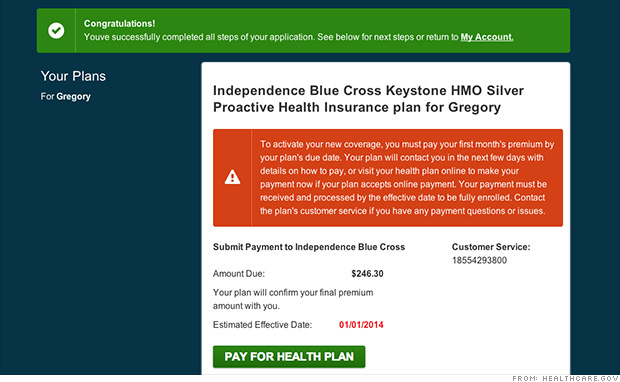
obamacare plan steps

You must pay your first month's premium before you are insured under Obamacare.

NEW YORK (CNNMoney)

If you want to be insured come Jan. 1, you have to pay your first month's premium by your insurer's due date, often Dec. 31.

Sounds simple enough, but federal officials and insurers are concerned that many consumers don't realize they have to take this last step and will remain uninsured. What's more, those who don't pay by then may have their Obamacare applications terminated, forcing them to re-enroll via healthcare.gov for coverage that will begin later in 2014.

The tight deadline and continuing errors with consumers' applications being sent to insurers also risk leaving some folks uncovered. Obama administration officials are advising consumers to check with their insurer of choice to make sure it received their application and payment and that coverage will begin Jan. 1.

Here's the timeline: Consumers have until Dec. 23 to pick an insurance plan on healthcare.gov, the federal Obamacare exchange handling enrollment for 36 states, if they want to be covered at the start of the new year. Once they do, a final screen confirms they've completed their application, but warns that they have to pay their first premium for coverage to be activated.

The site then provides a payment button that takes them to their insurer's website. Some companies accept online payments, but others give consumers information about how to take care of the bill.

Those who live in the 14 states (plus the District of Columbia) with their own exchanges face different deadlines. In Oregon, for instance, residents had to submit initial applications by Dec 4, while Californians have until Jan. 6 to make their first payment. Those planning to sign up this month should check the deadlines of both their exchange and their chosen insurer.

Share your story: Are you signing up for Obamacare?

While the Obama administration has reported that more than 100,000 Americans picked plans in October, the first month of open enrollment, it's not known how many of them have paid.

One insurer, Physicians Health Plan of Northern Indiana, has received payments from only about 20% of applicants, nearly all using the firm's online portal, said Jim Brunnemer, the chief financial officer. It is sending invoices and email reminders to those who haven't yet sealed the deal. If payment isn't made by New Year's Eve, PHP has been told by federal officials that it must void the application.

Another complication is that insurers also don't have a lot of time to process applications and send out ID cards. The timeline, particularly over the holiday week, will prove "challenging" for some companies, one industry executive said.

It usually takes 10 days for Scott & White Health Plan to activate an applicant, said Allan Einboden, chief executive of the Texas-based insurer. But the company will work with new enrollees to make sure that their prescriptions and other medical needs are covered in the early days of the new year.

"We have mechanisms to get people by," he said.

The process is being further complicated by the fact that insurers are receiving applications from healthcare.gov that contain errors, such as missing data. Some applications aren't getting through, so insurers don't know to follow up with these folks. Both of these problems are slowing down the enrollment process.

The issue is serious enough that federal officials are reaching out to applicants via phone and email to make sure they pay for a plan and contact their insurer to confirm enrollment.

"We will also make a concerted effort to reach consumers who selected a plan over the course of these past several weeks so that they know what their next steps would be," said Julie Bataille, a spokeswoman for the Centers for Medicare & Medicaid Services, which is managing healthcare.gov.

For those who miss gaining coverage starting Jan. 1, there's still time to sign up in 2014. Enrollment runs through March 31. To top of page

First Published: December 5, 2013: 7:30 AM ET


23.53 | 0 komentar | Read More

Pension postponed: Retire at 69 in U.K.

LONDON (CNNMoney)

Under the reforms, which were presented as part of a bi-annual economic update on Thursday, the pension age will be linked to rising life expectancy and reflect the U.K. government's belief that workers should spend no more than a third of their adult life in retirement.

The state pension age of 68 will now be enforced in the mid 2030s, about 10 years earlier than planned. And by the late 2040s it will rise to 69.

Related: Millenials may not be able to afford retirement

The new regime will give the U.K. one of the highest pension ages in the world by the middle of the century, according to the Organization for Economic Co-operation and Development.

In the United States and Germany, the retirement limit will hit 67 by 2050, compared to a more generous 65 for workers in Japan and Mexico. Only two other countries -- Italy and Denmark -- are expected to have a normal pension age as high as 69 by then, the OECD said.

Many countries are linking pensions to life expectancy as aging populations place increasing burdens on the state and government struggle to bring their borrowing under control.

By raising its pension age, the U.K. government said it will save £500 billion over 50 years.

The bitter news for young workers was delivered alongside an upbeat assessment of the U.K. economy.

Related: Germans get pensions boost

Chancellor George Osborne told lawmakers Britain is growing faster than any other major advanced economy and issued upgraded official GDP forecasts.

The Office for Budget Responsibility raised its estimates for U.K. growth in 2013 to 1.4%, from 0.6% predicted in March.

Forecasts for 2014 were raised to 2.4% from 1.8%. Faster growth should allow the government to generate a budget surplus by 2018/19.

The U.K. averted a triple-dip recession earlier this year to become one of Europe's best performing economies.

Yet the government, which faces an election in 2015, is facing growing criticism over a decline in living standards for many as wages fail to keep pace with the cost of living. To top of page

First Published: December 5, 2013: 11:05 AM ET


23.53 | 0 komentar | Read More

Japan to spend more to secure recovery

japan tsunami shinzo abe

Shinzo Abe's government backed his plan for a new round of economic stimulus.

LONDON (CNNMoney)

The government approved the stimulus package Thursday to neutralize the impact of a tax hike meant to start tackling the country's huge debt.

Some 5.5 trillion yen will be used to promote reconstruction work in areas worst affected by the March 2011 earthquake and tsunami.

Prime Minister Shinzo Abe hopes the measures will add about 1% to GDP and create 250,000 jobs.

The prospects for the world's third largest economy have brightened substantially since Abe first set out his ambitious plan to haul Japan out of years of stagnation and deflation.

Related: Year of Abenomics delivers Japan revival

A combination of government spending and massive monetary stimulus by the country's central bank has begun to bear fruit.

Growth accelerated sharply in the first half of the year, before slowing in the third quarter. Japanese shares have gained 60% in 12 months, and the yen has fallen about 20% against the dollar, boosting the fortunes of some of the country's biggest exporters.

The early success has boosted government coffers, allowing the new stimulus to be funded without additional borrowing, and created enough headroom for Abe to start tackling Japan's record 230% debt-to-GDP ratio.

A tax on sales -- paid by consumers when they buy goods or services -- will rise in April 2014 to 8% from 5%, and the government has the option to hike it again to 10% by 2015.

Abe is aiming to halve Japan's primary budget deficit by 2015 and deliver a surplus five years later.

Still, it is too early to call Abenomics a complete success. Wages have not gone up by much, and promised structural reforms have been difficult to implement.

Abe's government has proposed measures that would make the labor market more flexible, encourage immigration, bring nuclear power plants back online and draw more Japanese women into the workforce. But progress has been painfully slow.

-- CNN's Junko Ogura in Tokyo contributed to this article. To top of page

First Published: December 5, 2013: 8:21 AM ET


23.53 | 0 komentar | Read More

America's favorite small business is ...

trio hardware

Francesca and Bruce Carlow say Trio Hardware would not have been alive for 50 years without their community's support.

NEW YORK (CNNMoney)

And on Thursday, the Plainview, N.Y., store was rewarded for its commitment with the title of America's favorite small business.

For the third year in a row, advocacy group Independent We Stand has organized the Indie Awards, asking customers to nominate and vote for their favorite small businesses across the country. The contest, co-sponsored by Chrysler Group and STIHL Inc., drew over 32,000 votes for more than 250 businesses.

Trio Hardware, a family-owned business on Long Island, received 2,024 votes, nearly 10% of the city's population, which put it in the top 10. A panel of judges then selected the winner. In addition to bragging rights, the company will receive prizes worth $15,000.

"Our goal is to recognize a small business that has gone above and beyond with its customers and its community," said Bill Brunelle, executive director of Independent We Stand. "What stood out for us is how the community has rallied to keep Trio Hardware alive for so long."

Related: Startup turns illegal guns into jewelry

He's not exaggerating. In the '90s, residents staged a protest when the landlord tried to void the lease after a fire. More recently, there have been active campaigns to keep Home Depot (HD, Fortune 500) and Lowe's (LOW, Fortune 500) at bay.

"It's still affecting us that those stores are nearby, but it could have killed us if they were right in our community," said Trio co-owner Bruce Carlow.

The hardware store was started by Bruce's father in 1963. Its seven full-time employees -- two of whom recently became partners in the store -- have all worked there for at least 10 years. Bruce and his wife Francesca said their customers' loyalty also extends over decades.

Related: 5 Americans who launched startups in Chile

Elan Wurtzel has lived in Plainview for 26 years and has been shopping at Trio the entire time.

"I loved going into the store back in the day when it was just a typical hardware store with dirty wooden floors," said Wurtzel.

It's changed a bit since then, and the Carlows have worked hard to diversify their offerings "to keep up with the times and the competition," said Wurtzel.

In addition to power tools and nails, the 3,500-square-foot store also sells art and sewing supplies, kitchen and garden products, cell phone accessories -- even "bra extenders," said Carlow.

Related: Want loyal customers? Build a culture of saying yes

But for Wurtzel, the store's biggest appeal is how the Carlows and their employees treat customers.

"Every employee knows what they're talking about," he said. "They never say no to you. If they don't have something, they'll order it for you."

A number of respondents said the top-notch customer service was why Trio should receive the Indie Award.

Carlow said Trio Hardware's employees know most of their customers by first name. "We like to give the kind of service that we want to receive ourselves," he said.

Bruce said he and Francesca have thought about growing the business but haven't acted on it.

"Could we possibly make more profits if we expand? Yes. But I think we'd lose our personality," said Bruce. To top of page

First Published: December 5, 2013: 7:07 AM ET


23.53 | 0 komentar | Read More

GM to discontinue Chevrolet brand in Europe

2014 chevrolet corvette convertible

GM is winding down its Chevrolet brand in Europe, except for the Corvette, like this 2014 Stingray exhibited at the LA Auto Show.

NEW YORK (CNNMoney)

"The company's Chevrolet brand will no longer have a mainstream presence in Western and Eastern Europe, largely due to a challenging business model and the difficult economic situation in Europe," GM announced on Thursday.

The U.S. automaker said that, beginning in 2016, it will compete in European markets through its Opel and Vauxhall auto brands, which are already being sold there.

GM (GM, Fortune 500) also said it will "tailor its presence to offering select iconic vehicles -- such as the Corvette -- in Western and Eastern Europe, and will continue to have a broad presence in Russia and the Commonwealth of Independent States."

The Commonwealth is an organization of former Soviet countries, including Russia, Kazakhstan, Georgia and Ukraine.

Related gallery: Ford unveils all-new Mustang

GM said that its decision to wind down the Chevrolet brand in Europe will result in "net special charges" of $700 million to $1 billion in the fourth quarter of 2013 and the first half of 2014. These charges will stem from "deal restructuring" and "severance-related costs" as well as other expenses.

The company said that most of the Chevrolet cars sold in Europe are manufactured in South Korea.

GM is one of the biggest automakers in the world, competing with U.S. manufacturers Chrysler and Ford (F, Fortune 500) as well as Japanese manufacturer Toyota (TM). To top of page

First Published: December 5, 2013: 9:24 AM ET


23.53 | 0 komentar | Read More

Job growth drives mortgage rate jump

NEW YORK (CNNMoney)

The 30-year, fixed-rate loan, the most popular product for homebuyers, rose to 4.46% from 4.29% last week. The average rate on a 15-year, fixed-rate mortgage, typically used for refinancing higher interest mortgages, also jumped 0.17 percentage point to 3.47%.

This week's rate approached a high for the year. Rates on the 30-year have ranged from a low of 3.34% in the first week of January to a high of 4.58% in August.

Related: American Dream homes: What you'll pay in 10 cities

Frank Nothaft, Freddie's chief economist, cited job creation as a prime reason for the rate spike.

"Private companies added 215,000 new jobs in November according to the ADP employment report, well above the consensus," he said. "In addition, revisions added 54,000 jobs in the prior month."

There were also strong reports from home builders. New home sales surged 25% in October.

Related: Million dollar housing markets

Keith Gumbinger, vice president of mortgage information site HSH.com, said that solid showings by manufacturers added to the positive economic climate. Automakers reported that sales are at their highest level since early 2007.

"If the economy is gaining steam, even just a little, mortgage and other interest rates will firm right along with it," he said. To top of page

First Published: December 5, 2013: 10:21 AM ET


23.53 | 0 komentar | Read More

Investors brace for big dip in stocks

SP ytd

The S&P 500 is on fire this year. Some investors think a pullback is needed. Click the chart for more market data.

NEW YORK (CNNMoney)

It's been 26 months since the S&P 500 slipped into a "correction," defined as a decline of 10% or more from a recent high, according to Sam Stovall, chief equity strategist at S&P Capital IQ.

On average, the index has gone through a correction every 18 months since 1945, Stovall wrote in a report this week.

The S&P 500 slid 5.7% from late May through late June, after the Federal Reserve hinted that it could scale back, or taper, the bond purchases that have helped fuel the bull market in stocks since March 2009.

Other than that, stocks have not had a drop of more than 5% all year. The S&P 500 is up more than 25% this year and has hit a series of all-time highs.

The broad market gauge has ended higher every week for the past eight weeks. But that winning streak is in jeopardy. The S&P 500 has fallen for the past four days.

Related: 20 top picks from 20 star investors

As stocks have pulled back, the market's so-called fear gauge has popped higher. The VIX (VWA), a measure of market volatility, has gained 15% over the past three days, though it's still at historically low levels.

And CNNMoney's Fear and Greed Index, which tracks the VIX and six other gauges of market sentiment, has fallen in the past week. It's still at Greed levels but was much closer to Extreme Greed a week ago.

Jack Ablin, chief investment officer at BMO Private Bank, said it's too soon to tell if this week's selling is the beginning of a larger correction.

Ablin said much will depend on Friday's jobs report, which could give investors a better sense of what the Fed might say about tapering at its next policy meeting, which concludes on December 18.

Related: Don't fight the Fed, but be wary

Stocks have been under pressure this week despite strong reports on manufacturing and private-sector payrolls as some investors see good economic news as a sign that tapering is imminent.

"If we get a good jobs report and the market drops, that may suggest that investors' attitudes have shifted," said Ablin.

Dan Greenhaus, market strategist at BTIG, said that stock prices are a "bit stretched" right now, based on how high the S&P 500 is above its average level over the past 200 days. He and thinks that a pullback of 5% would not be surprising. But he argued that stocks do not need to fall just because it's been a good year for the market. While stocks are more expensive than a year ago, he said valuations are still not abnormally high.

The S&P 500 is trading at 15 times next year's earnings estimates, compared with a 10-year average of 14, according to data from FactSet.

Related: Bulls look for new highs in December

But John Linehan, head equity strategist at T. Rowe Price, said the market's green light has turned "decidedly yellow" and investors should "proceed with caution." He says that stocks are "probably due" for a correction in 2014.

Another reason to be cautious? The current bull market is now 57 months old, which is the average life-span for bull markets going back to 1928, according to T Rowe Price.

Still, Linehan thinks that a correction could be healthy. Any significant pullback "is probably a buying opportunity more than anything else."

In fact, Linehan expects the S&P 500 to end 2014 with gains "in the high single or low double digits." That's obviously not as strong as this year's gains, but it would still be a very good year for stocks. To top of page

First Published: December 5, 2013: 10:22 AM ET


23.53 | 0 komentar | Read More

Stocks slump again

Dow 10

Click for more market data.

NEW YORK (CNNMoney)

The Dow Jones industrial average, the S&P 500 and the Nasdaq were all lower in early trading. The Dow and S&P 500 are coming off four straight days of losses.

The government revised its initial report on third-quarter economic growth to 3.6%, up from the previous estimate of 2.8%. The improvement was largely driven by inventory growth as companies restocked their shelves ahead of the holiday shopping season.

And the number of Americans filing first-time claims for unemployment benefits fell more than expected last week, the Labor Department said. Economists said the decline may have been distorted by the Thanksgiving holiday.

But the upbeat economic news failed to boost the market. Many investors believe that good economic news makes it more likely that the Federal Reserve will begin scaling back, or tapering, its monthly bond purchases.

The yield on the 10-year Treasury rose to 2.86% after the economic reports were released. Bond yields rise when prices fall. So bond investors are selling Treasuries in anticipation that the Fed may no longer buy as much going forward.

The Fed's $85-billion per month bond buying program has helped fuel the bull market since March 2009. But the central bank signaled earlier this year that it hopes to gradually reduce the purchases as the economy recovers. It has said that improvement in the job market could trigger this process.

The government's November jobs report is due Friday. Economists surveyed by CNNMoney expect that report to show 183,00 jobs were added last month.

Related: Where should you put your money now?

But not everyone is convinced the Fed will taper at its next policy meeting -- which wraps up on December 18. Alastair McCaig, market analyst for IG in London, said the holiday shopping season would be "a fragile time of year" for the Fed to pull back on its bond purchases.

"Trying to squeeze something in before the end of the year would start a little bit of panic, the tail end of December being just an incredibly important retail period," he said. "It would be a little bit dangerous to do something this year."

What's moving: On the corporate front, Jos. A Bank (JOSB) reported a decline in quarterly net sales and net income, compared with the prior year. The clothing retailer has been in a bizarre takeover battle with Men's Wearhouse (MW), which originally rebuffed a hostile bid from Jos. A Bank before turning the tables and offering to buy its smaller rival.

Apple (AAPL, Fortune 500) shares rose following a report that the company is nearing a deal with China Mobile (CHL) to sell Apple's iPhone. China Mobile is the world's largest mobile carrier.

Shares of discount retailer Dollar General (DG, Fortune 500) rose after the discount retailer reported quarterly earnings that beat analysts' expectations and raised the lower end of its outlook for full-year profits.

Related: Fear & Greed Index still shows greed despite recent sell-off

European markets edged lower after the European Central Bank and the Bank of England both voted to hold interest rates steady. Asian markets ended mostly lower. To top of page

First Published: December 5, 2013: 9:52 AM ET


23.53 | 0 komentar | Read More

White House: Extend jobless benefits

job fair

Job fair: Some 1.3 million unemployed workers will lose federal benefits by Dec. 28, but the White House wants Congress to extend help another year.

WASHINGTON (CNNMoney)

Benefits for 1.3 million workers will expire Dec. 28 if Congress fails to extend a recession-era program by the end of this month.

On Thursday, the White House Council of Economic Advisers and Department of Labor issued a joint report touting how jobless benefits buoy the economy, while keeping 2.5 million workers out of poverty each year.

Allowing unemployment benefits to expire "would be harmful to millions of workers and their families," according to the report.

President Obama started using his bully pulpit this week to put more pressure on Congress to extend the program.

Related: Private Sector hiring stronger

"Christmas-time is no time for Congress to tell more than 1 million of these Americans that they have lost this unemployment insurance," Obama said in a speech on Wednesday. "(That's) what will happen if Congress does not act before they leave on their holiday vacation,"

The White House points out that if benefits expire, U.S. GDP could fall next year by 0.2 to 0.4 of a percentage point, according to the Congressional Budget Office and a J.P. Morgan Chase (JPM, Fortune 500) economist.

The report also suggests the economy isn't strong enough to end benefits.

The program was first signed into law in June 2008 by President George W. Bush, when the unemployment rate was 5.6 percent and the average duration of jobless insurance was 17.1 weeks.

The unemployment rate climbed to more than 10% at the height of the Great Recession in 2009, and the government extended the federal benefits to jobless Americans whose state unemployment insurance had run out.

However, thanks to a weak recovery, those benefits have been either extended or expanded 11 times, most recently on Jan. 2 . Today, the unemployment rate is at 7.3%, and the average duration of the benefits is 36.1 weeks.

Related: I will lose my jobless benefits by year end

Federal unemployment insurance benefits kick in after a person's state benefits run out, and range between 14 to 47 weeks, depending on the state a person lives.

Only residents in Nevada and Illinois have access to the maximum 47 weeks, according to the National Employment Law Project, an advocacy group. Most states have cut back unemployment benefits, as the labor market has improved.

"As lawmakers prepare to head home to be with their families during the holiday recess, they must not turn their backs on millions of families struggling with long-term unemployment and a weak labor market," said Christine Owens, executive director of the National Employment Law Project in a statement.

The cost to extend the federal benefits by another year is about $26 billion, according to the Congressional Budget Office.

Democrats filed a bill to extend benefits by a year this week.

But Republicans have been cool to the idea. Republicans say the program was intended to be temporary and has cost $252 billion through July. That's more than other unemployment insurance programs during the recessions of 2001, 1991, and 1982, according to a House Republican website.

A request for comment with House Republicans on the budget panel was not immediately returned. To top of page

First Published: December 5, 2013: 11:06 AM ET


23.53 | 0 komentar | Read More
techieblogger.com Techie Blogger Techie Blogger